
FitBeast Pull Up Bands Set, 5 Different Levels Resistance Band Pull Up for Calisthenics, Bodywei
£21.99
View on Amazon →
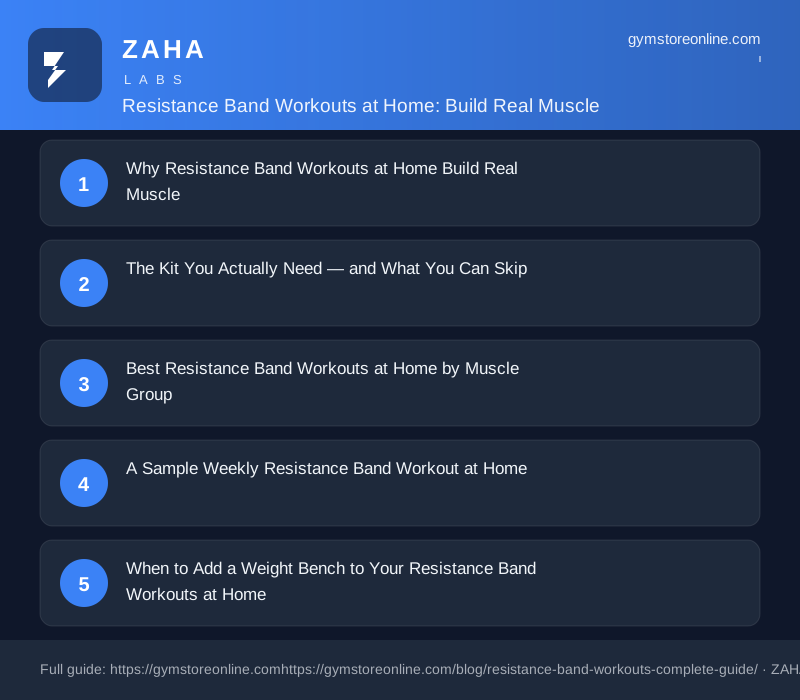
Published 17 September 2026 · updated 2026-09-17 · by GymStoreOnline
A £20 set of resistance bands and three square metres of floor space is enough to run effective resistance band workouts at home that genuinely build muscle. No commute, no membership, no complicated equipment — just consistent progressive loading in your own space.
Resistance bands produce what coaches call "accommodating resistance." As the band stretches, the load increases — so peak tension lands at the top of the movement, exactly when the muscle is fully contracted and most capable of generating force. Compare that to a dumbbell curl, where resistance drops at the top.
Progressive resistance training builds lean tissue regardless of the tool. What matters is consistent overload over time. Bands provide that stimulus quietly, in a small space, without dropping plates on the floor at midnight.
They also protect joints. The smooth elastic force curve is kinder to tendons and ligaments than sudden impact loading, making bands particularly useful for anyone returning from injury or training on a hard floor above a downstairs neighbour.
You do not need a full rack of bands on day one. Start with two or three resistance levels:
Long looped flat bands handle lower-body work well. Tube bands with handles suit pressing and pulling movements. Mini loops — the small flat loops used for glute work — are sold separately and worth adding once you are past the beginner stage.
What to skip on your first purchase: a dedicated door anchor frame and resistance band stackers are useful but not essential. A loop around a bedpost, stair banister or the leg of a weight bench serves the same anchoring function for most exercises.
Loop your band around a fixed anchor — a staircase banister, a table leg, or the base of a weight bench — then pull sharply to test it before you add full bodyweight tension. The anchor needs to handle at least twice the band's rated resistance without shifting.
Banded chest press: Lie on your back, loop the band behind your upper back and press both handles forward. On the floor your range of motion is limited; an adjustable weight bench immediately fixes this. Adding incline and decline angles shifts load toward different chest fibres — the upper chest responds best to a 30–45 degree incline, while a flat or slight decline works the mid and lower portions through a longer range.
Banded lateral raise: Stand on the band, hold both ends at your sides and raise your arms to shoulder height. Pause for one second at the top. This is one of the few exercises that loads the side deltoid effectively without a cable machine or heavy dumbbell.
Banded face pull: Anchor the band at face height — a door anchor, stair rail or the top of a squat rack frame all work. Pull both handles toward your face, driving elbows wide and rotating your shoulders externally. Include this in every session; it does more for long-term shoulder health than almost any other bodyweight or band exercise.
Seated banded row: Sit on the floor, loop the band around your feet and pull both handles toward your lower chest. Drive the elbows back rather than flaring them wide. Squeeze between the shoulder blades at the end of each rep.
Banded pull-apart: Hold the band at arm's length in front of your chest. Pull it apart until your hands reach your sides. Simple, effective, and excellent for posture correction after long periods at a desk. Three sets of 20 reps.
Banded bicep curl: Stand on the band with feet hip-width apart, curl both handles with palms facing up. To keep the resistance curve honest, use a single heavier band rather than doubling a light one.
Banded squat: Stand on the band with feet hip-width apart, handles resting at your shoulders. Squat to parallel keeping your chest tall and knees tracking over your toes. Move to a heavier band as soon as 15 reps starts to feel easy — the legs respond to higher loads better than most muscle groups and you will outgrow light bands quickly.
Hip thrust: Sit on the floor with your upper back against a bench or sofa edge. Loop a flat band across your hip creases, plant both feet firmly, and drive your hips toward the ceiling. Squeeze the glutes hard and hold for one second at the top. This is the most effective glute exercise available to home trainers. The height of a bench matters here — training off the floor limits the range of motion significantly.
Lateral band walk: Place a mini loop just above your knees. Take ten steps sideways, then ten steps back, keeping your hips level throughout. Excellent as a warm-up before squats and for building the hip abductor strength that protects the knee during loaded movements.
Banded pallof press: Anchor the band at chest height. Stand sideways on, hold the handle at your sternum and press straight out. Hold two seconds, return slowly. The rotational pull on the core works the obliques harder than most floor-based crunching exercises and trains anti-rotation — a more functional demand than simply bending sideways.
This three-day full-body structure suits beginners and intermediate trainees alike. Leave at least one full rest day between sessions.
| Day | Session focus | Example exercises |
|---|---|---|
| Monday | Push + core | Chest press, overhead press, lateral raise, pallof press |
| Wednesday | Pull + hinge | Row, face pull, bicep curl, Romanian deadlift, hip thrust |
| Friday | Squat + lower body | Banded squat, hip thrust, lateral walk, glute kickback |
For each exercise: 3 sets of 10–15 reps. When 15 reps feels comfortable with clean form, move to the next resistance level. That is progressive overload — the only mechanism that produces lasting muscle growth, regardless of the tool used.
A resistance band under full tension stores real energy. Check every band before each session for nicks, cracks, discolouration or splits near the join points where the latex meets the handle clip. A snapping band can whip the face or hand with significant force. Replace any damaged band immediately — they cost very little to replace and cannot be safely repaired.
A bench is the single most impactful upgrade for home resistance band training. It removes the floor limitation on chest press range of motion, unlocks proper hip thrust mechanics, and opens incline and decline angles that recruit different muscle fibres.
The YOLEO Adjustable Weight Bench (£69.99, 4.6 stars) is ASTM-certified to 300–375 kg, adjusts across 84–90 positions including incline, decline and flat, and arrives 98% pre-assembled. That range of angles is meaningful: a 45-degree incline shifts the chest press load toward the upper chest; a modest decline takes the lower chest through a longer range. The ASTM certification matters for a weight-bearing product — it indicates independent structural testing, not just a manufacturer claim.
For those ready to add barbell work alongside band training, the TOTEBOX Adjustable Squat Rack Barbell Stand (£56.99, 4.6 stars) includes a push-up bracket, spotter arm and dipping bar — three pieces of equipment in one unit. Resistance bands looped over the uprights add variable tension to barbell movements, a technique commonly used in strength programmes to overload the top portion of a lift.
The Yaheetech Adjustable Squat Rack (£49.98, 4.4 stars) performs a similar dual role as both a power bench support and dip station at a lower price point, useful if bodyweight dips and pull progressions sit alongside your band programme.
For an all-in-one home station, the YOLEO 400–900KG ASTM-Certified All-in-One Weight Bench Set (£99.99, 4.6 stars) adds a bench press rack with leg extension and leg curl fixture. Resistance bands can loop through the frame to add accommodating resistance to every loaded movement — a versatile configuration for a compact one-room home gym.
If budget is the primary constraint, the OZE SPORTS Adjustable Weight Bench (£39.99, 4.5 stars) covers the incline, flat and decline positions needed for band-based chest and shoulder work without the outlay of a full rack.
Every product we reference carries a minimum 4.4-star rating. For weight-bearing equipment we look for ASTM structural certification, a meaningful rated capacity (300 kg minimum for benches), and a pre-assembly level that reduces the risk of incorrect setup. Price caps keep recommendations practical: benches and racks at or under £100 for this guide.
For resistance bands themselves, the criteria to check before purchasing are: stated resistance range in lb or kg, natural latex or heavy-duty TPE construction (check for latex sensitivity before buying), and stitched rather than glued loop joints at the ends.
A strong fit if you:
Consider alternatives if you:


Yes, provided you apply progressive overload consistently — moving to heavier bands or completing more reps over time. Research shows resistance training builds lean muscle regardless of the tool, as long as the load is sufficient and progressive. Most people find bands effective for the first 12–18 months before genuinely outgrowing the highest resistance in a standard set. At that point, adding a barbell or heavier cable system is the natural next step.
Start lighter than you expect. A band that feels easy for the first few reps will challenge you properly by the twelfth or fifteenth. If you can complete 15 clean reps without compensating your posture, move to the next resistance level. Most starter sets include three to five levels, and working through them over six to twelve months is a normal, healthy trajectory for a beginner to intermediate home trainer.
Not to start, but a bench makes a meaningful difference. Hip thrusts performed off the floor limit range of motion significantly; an adjustable bench like the OZE SPORTS Adjustable Weight Bench (£39.99) or the YOLEO Adjustable Weight Bench (£69.99) raises the hips through a full movement arc. A bench also opens incline and decline chest press angles that cannot be replicated on the floor. It is the single most impactful upgrade once band training is established.
Three full-body sessions per week is the standard recommendation for beginners — enough stimulus for muscle adaptation with sufficient rest between sessions. As you advance, some trainees move to four sessions using an upper/lower split. Daily band work is not advised unless sessions are short and low-intensity, such as mobility or warm-up work, as muscle fibres need roughly 48 hours to repair and adapt between hard training sessions.
As an Amazon Associate we earn from qualifying purchases. Prices and availability are accurate as of the date shown and are subject to change — the price on Amazon at checkout is the one that applies.
Find the best adjustable bench for ab and core workouts at home. UK guide covering angles, load ratings and picks under £100 for e
Everything you need to choose the best adjustable dumbbells for home workouts: weight range, locking mechanisms, build quality and
Build your home barbell and weight plate setup right: what to look for in bars, plates, squat racks and benches. Real specs, UK pr