
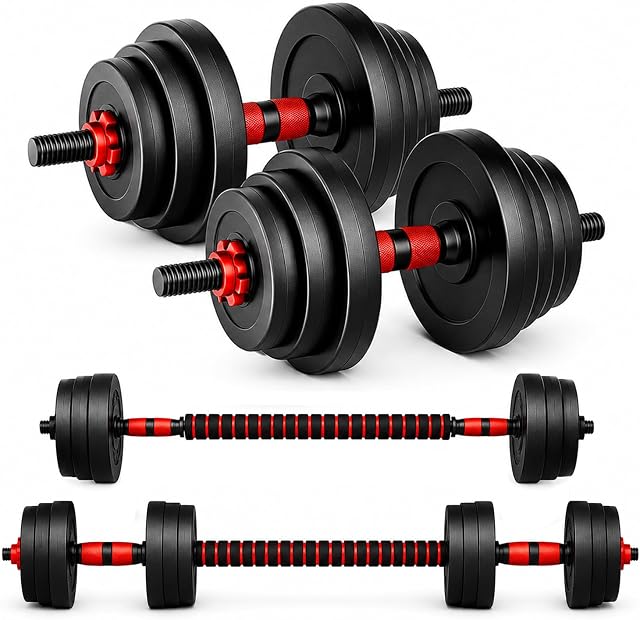
Northdeer Dumbbells Set, Adjustable Ultracompact Chrome Weights Home | Adjustable 2.5kg 5kg 7.5k
£79.90
View on Amazon →
Published 17 September 2026 · updated 2026-09-17 · by GymStoreOnline
A single pair of adjustable dumbbells can replace an entire rack of fixed weights and occupies less floor space than a kitchen chair — yet most home gym buyers still overspend on sets they outgrow within a year. The best adjustable dumbbells for home workouts combine a 5–52 lb range, a reliable locking mechanism, and a secure cradle that keeps plates properly aligned between sets.
This guide covers what to check before you buy: how much weight range you actually need, which locking mechanism suits your training, what materials signal quality, and which weight benches pair naturally with your dumbbells.
The most common mistake is buying too light. A 25 lb top end feels adequate for curls and lateral raises, but compound movements — Romanian deadlifts, bent-over rows, heavy goblet squats — progress quickly once technique is dialled in. A 50 lb top end per dumbbell gives you realistic headroom for two to three years of consistent home training.
At the light end, the increment size matters almost as much as the maximum. A 5 lb jump between settings is workable for leg and back work. For shoulder isolation — lateral raises, front raises, rear-delt flys — 2.5 lb increments make a meaningful difference to joint safety and progressive overload. Check whether your shortlisted set offers 2.5 lb steps at the lower end, or whether that requires a separate add-on plate purchase.
For most home workout programmes, a range of 5–52.5 lb covers warm-up through working weight across the full exercise spectrum. Those planning to do heavy pressing or loaded carries may want to look at sets extending to 70–90 lb per dumbbell.
A rotating dial at each end of the handle selects the plate count; unused plates stay in the cradle. Adjustment takes three to five seconds — fast enough to swap weights between supersets without breaking your pace. The trade-off is that the selector components are typically plastic and absorb more wear than the plates themselves. A solid cradle is essential: the plates must seat cleanly so they cannot shift when you pick the dumbbell up. If the cradle flexes under the load, the plates can rattle or unseat mid-rep.
You rotate the handle ends to engage the plates you want, leaving the rest in the tray. Slower to adjust than a dial — typically 10–15 seconds — but the mechanism is simpler and more durable over time. This system suits lifters who set a weight and hold it across multiple sets rather than swapping mid-circuit. The primary wear point over years of use is the collar thread.
A steel pin slides through the handle to lock chosen plates. No plastic in the load path, no collar thread to wear. Adjustment is slowest of the three — upwards of 20 seconds per dumbbell — but the mechanism is the most durable and the most repairable if something eventually fails. Handles tend to be longer and bulkier than the other two types.
If you do circuit or superset training and swap weights frequently, a selector-dial set pays back its higher price in speed. If you do straight sets of heavy compound work and rarely change weight mid-session, twist-lock or pin offers better long-term durability for the money.
The handle is where safety and comfort are decided. Look for a steel core — cast-iron handles exist but are heavier and less common in adjustable sets. Knurling or rubberised grip prevents the handle rotating in the palm under sweat; smooth chrome looks clean in product photos but becomes unreliable at real training intensity. Check that the knurl pattern covers the full grip width, not just a narrow central strip.
Plate coatings affect longevity and floor safety. Urethane-coated plates chip less, resist odour, and are gentler on rubber gym mats. Rubber-coated plates are cheaper but can develop a persistent smell in enclosed spaces — a real issue in UK garages and loft rooms pressed into service as home gyms. Bare iron plates are functional but surface-rust in damp conditions unless stored dry and occasionally wiped with a lightly oiled cloth.
The cradle is frequently underestimated. It needs to hold the plates aligned for re-racking, sit flat on the floor without tipping, and bear the weight of the full stack without flexing. A cradle that rocks or has shallow plate slots makes re-racking after a heavy set unnecessarily awkward and raises the risk of a plate shifting during a lift.
Some listings advertise the handle price and sell weight plates separately. The headline price on a selector-dial set should include all plates up to the stated maximum. If the product title or first bullet point contains the words "handle" or "handle only", the plates are extra — and the complete set often costs two to three times the listed figure. Read titles carefully before clicking through.
A 50 lb selector-dial pair on two cradles typically occupies a footprint of roughly 60 cm wide by 25 cm deep — similar to a standard dining chair. That is the permanent resting position; you also need an unobstructed workout zone around it. Measure both before buying, not just the intended floor plan.
Freestanding dumbbell racks are the most flexible storage option and keep the set mobile if you reorganise the room. Wall-mounted shelves save floor space but require secure fixings into studs or masonry — the combined weight of a loaded adjustable set is not trivial. If you plan to own two pairs (a light set for shoulder isolation and a heavier set for compound work is a common progression), a dedicated rack pays back in convenience and floor space within a few weeks.
Dumbbells on their own handle goblet squats, farmer carries, rows, and standing overhead presses well. To unlock chest pressing at multiple angles, incline fly, and seated shoulder work, an adjustable weight bench is the single most valuable companion piece — and the one that turns a pair of dumbbells into a full training system.
The OZE SPORTS Adjustable Weight Bench (£39.99, 4.5 stars) is a foldable incline/decline/flat utility bench built for full-body home workouts. Its multiple angle positions cover dumbbell pressing at various inclines and seated overhead work, and it folds flat when not in use to reclaim floor space.
For more consistent heavy use, the YOLEO Adjustable Weight Bench (£69.99, 4.6 stars) is ASTM-certified to 300–375 kg, ships 98% pre-assembled, and offers 84–90 angle positions from decline through to near-vertical. The wide angle range suits both dumbbell chest pressing at multiple inclines and steep-angle seated shoulder pressing without needing to swap equipment.
If you anticipate adding a barbell to your setup later, the YOLEO 400–900 KG ASTM-Certified All-in-One Weight Bench Set (£99.99, 4.6 stars) includes a bench press rack with leg extension and curl attachments — a single frame that grows with your kit without requiring a separate squat rack purchase.
For a more complete station from day one, the SPORTNOW 420 KG Weight Bench with Adjustable Bench Press Rack and Dip Station (£83.59, 4.4 stars) combines a flat/incline bench with a press rack and dip station in a single heavy-duty frame. The 420 kg capacity provides significant headroom well beyond typical home gym loads.
A bench only needs to support your bodyweight at the chosen angle — the dumbbells load your muscles, not the bench frame. Capacity ratings matter primarily for long-term structural durability and resale stability.
| Feature | Selector Dial | Twist-Lock | Pin-and-Hole |
|---|---|---|---|
| Adjustment speed | 3–5 seconds | 10–15 seconds | 20+ seconds |
| Primary wear point | Plastic selector | Collar thread | Minimal |
| Typical top weight | 52.5 lb | 70+ lb | Variable |
| Best for | Circuits, supersets | Heavy straight sets | Maximum durability |
| Cradle required | Yes | Yes | Yes |
A good fit if you:
Consider alternatives if you:
We applied a minimum 4.4-star rating floor to all products referenced on this page. Benches were assessed for published load capacity, ASTM certification, pre-assembly percentage, and confirmed angle positions — all verifiable specifications rather than marketing language. Price points span entry-level through higher-capacity options to reflect different training stages and budgets. No product inclusion is paid for or sponsored.


For most beginners, a set running from 5 lb to 40 lb covers the first 12–18 months of consistent training. Light weights (5–15 lb) handle shoulder isolation and warm-up sets; mid-range weights (20–35 lb) cover rows, presses, and goblet squats as strength builds. Avoid the temptation to cap out at 25 lb — compound movements progress faster than most beginners expect, and you will want the headroom sooner than you think.
No — many effective dumbbell workouts are done standing or on the floor. Romanian deadlifts, goblet squats, farmer carries, and overhead presses all require no bench. A bench does, however, unlock chest pressing at multiple angles, seated shoulder pressing, and supported single-arm rows. If chest development is a training priority, an adjustable weight bench — such as the OZE SPORTS at £39.99 or the YOLEO at £69.99 — is the first companion piece worth buying.
The weight plates themselves are essentially indefinite under normal home use — cast iron and steel do not wear out. The limiting factor is the adjustment mechanism. Selector-dial plastic components can show wear after two to five years of daily use; twist-lock collar threads wear over a similar timeframe with regular loading. Choosing a pin-and-hole system or a brand with available spare parts extends the practical lifespan considerably and avoids the cost of replacing the full set.
For most programme templates, yes. A 5–52 lb adjustable set paired with an adjustable weight bench covers the vast majority of compound and isolation exercises in standard home training programmes. What home training cannot replicate is heavy barbell work above roughly 50 kg per side, cable machine exercises, and the social environment of a gym. If your routine is primarily dumbbell-based, the combined cost of a quality set and bench typically pays back within six to twelve months of avoided membership fees.
As an Amazon Associate we earn from qualifying purchases. Prices and availability are accurate as of the date shown and are subject to change — the price on Amazon at checkout is the one that applies.
Find the best adjustable bench for ab and core workouts at home. UK guide covering angles, load ratings and picks under £100 for e
Everything you need to choose the best adjustable dumbbells for home workouts: weight range, locking mechanisms, build quality and
Build your home barbell and weight plate setup right: what to look for in bars, plates, squat racks and benches. Real specs, UK pr